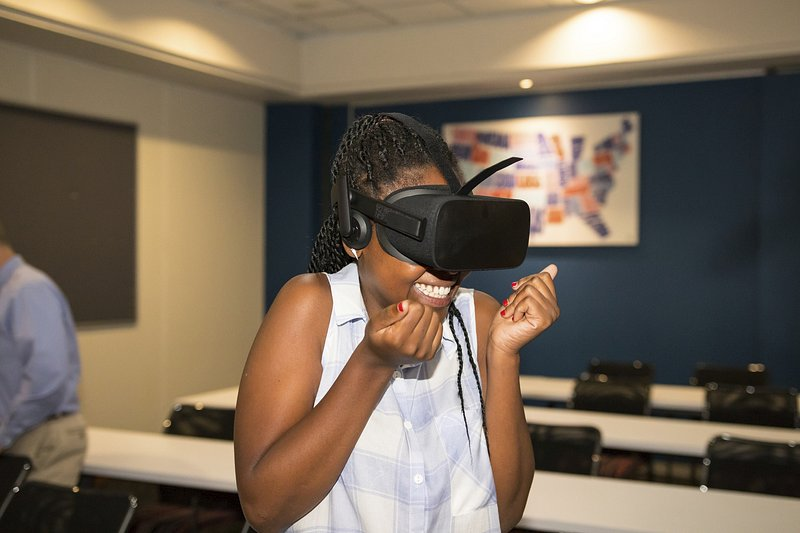
Technology has transformed how we experience the world, and two of the most exciting innovations leading that change are Virtual Reality (VR) and Augmented Reality (AR). Although both create immersive digital experiences, they function in distinct ways. Virtual Reality replaces your surroundings entirely with a computer-generated environment, while Augmented Reality overlays digital information onto the real world.
Understanding the difference between VR and AR is essential as both technologies are shaping industries such as gaming, education, healthcare, and business.
Understanding Virtual Reality (VR)
Virtual Reality (VR) is a technology that transports users into a completely digital world. Using headsets like Oculus Quest, PlayStation VR, or HTC Vive, VR immerses users in a simulated 3D environment that they can explore and interact with.
VR relies on motion sensors, controllers, and sometimes haptic feedback devices to enhance realism. Whether you’re walking through ancient ruins, piloting a spaceship, or attending a virtual meeting, VR gives the sensation of being physically present in a different world.
Key Features of VR
- Full Immersion: The user is completely surrounded by a virtual environment.
- Hardware-Dependent: Requires headsets and, in some cases, additional gear for interactivity.
- Controlled Environment: Everything you see and experience is computer-generated.
- Applications: Gaming, training simulations, therapy, virtual tourism, and education.
VR is often used to create experiences that would be difficult, dangerous, or expensive to reproduce in real life — such as pilot training, medical surgeries, or deep-sea exploration.
Understanding Augmented Reality (AR)
Augmented Reality (AR), on the other hand, enhances the real world by overlaying digital elements such as images, text, or sounds on top of it. Unlike VR, AR doesn’t replace your surroundings — it adds to them.
AR can be experienced through smartphones, tablets, or AR glasses like Microsoft HoloLens or Apple Vision Pro.
For instance, apps like Pokémon GO and IKEA Place use AR to merge virtual objects with the user’s real environment. When you look through your device, you can see both your surroundings and the digital elements interacting with them.
Key Features of AR
- Real-World Integration: The physical environment remains visible, enhanced by digital layers.
- Easily Accessible: Works on everyday devices like smartphones.
- Interactive Experience: Users can manipulate digital objects within the real world.
- Applications: Retail, healthcare, education, advertising, and navigation.
AR bridges the gap between the digital and physical worlds, making it ideal for interactive learning, product visualization, and real-time assistance.
Core Differences Between VR and AR
Although both technologies use advanced imaging and sensors, their approach and purpose differ significantly. Below are the core distinctions:
| Feature | Virtual Reality (VR) | Augmented Reality (AR) |
|---|---|---|
| Environment | Fully digital | Real-world with digital overlays |
| Immersion Level | Completely immersive | Partially immersive |
| Hardware Required | VR headset, motion sensors | Smartphone, tablet, or AR glasses |
| Interaction | Entirely virtual | Real-world interaction with digital elements |
| Primary Use | Simulation, training, entertainment | Real-world enhancement, education, retail |
| Mobility | Limited (requires setup) | Highly mobile (portable devices) |
In short, VR isolates you from the real world, while AR enhances your perception of it.
Applications of Virtual Reality
VR has grown beyond gaming and entertainment to include many practical applications:
- Education and Training: VR is used to simulate real-world environments for pilots, surgeons, and engineers.
- Therapy: Virtual environments help patients with phobias, PTSD, or physical rehabilitation.
- Architecture and Design: VR enables 3D visualization of buildings and interiors before construction begins.
- Social Interaction: Platforms like VRChat allow people to meet, talk, and play games in virtual worlds.
As technology advances, VR is becoming more affordable and accessible, opening opportunities for immersive learning and remote collaboration.
Applications of Augmented Reality
AR’s real-world integration makes it a powerful tool across industries:
- Retail: AR lets customers “try before they buy,” visualizing furniture or clothing before purchase.
- Healthcare: Surgeons use AR overlays to view anatomical structures during operations.
- Education: AR apps bring textbooks to life, allowing students to explore 3D models.
- Navigation: AR-enhanced maps and car dashboards provide real-time directional cues.
- Marketing: Brands use AR filters and experiences to engage audiences on social media.
AR’s blend of real and digital information enhances everyday experiences while keeping users connected to their surroundings.
The Role of Mixed Reality (MR)
As technology evolves, a hybrid concept called Mixed Reality (MR) is emerging. MR combines elements of both VR and AR, allowing virtual and real-world objects to interact in real time.
Devices like Microsoft’s HoloLens 2 and Apple Vision Pro use MR to enable users to manipulate holograms in real space. This next-level interaction could redefine how we work, learn, and communicate in the digital age.
Which Is Better: VR or AR?
Choosing between VR and AR depends on your goals.
- Choose VR if you want complete immersion and full digital experiences — perfect for gaming, simulations, and virtual training.
- Choose AR if you want to enhance real-world experiences — great for productivity, education, or customer engagement.
Both technologies complement each other, and in many cases, businesses use them together to create versatile solutions.
The Future of VR and AR
The future of both Virtual and Augmented Reality looks incredibly promising. With the rollout of 5G and improvements in AI, these technologies are becoming faster, more realistic, and more accessible.
Soon, we’ll see the rise of the metaverse, a shared virtual space where VR and AR converge, enabling seamless interaction between digital and real worlds.
As adoption grows, the line between reality and technology will continue to blur — opening up endless possibilities for creativity, education, and innovation.
Final Thoughts
Virtual Reality and Augmented Reality represent two sides of the same coin — both changing how we see, learn, and interact with our environment.
While VR immerses us in completely new worlds, AR enriches the one we live in. Together, they are redefining communication, entertainment, and work in the digital age.
As technology continues to evolve, understanding the difference between VR and AR will help businesses and individuals harness their full potential in an increasingly connected future.